
The World Designs for Sameness. We Design for Difference
Designing For Difference
Most workspace design optimises for the average. The average body. The average brain. The average sensory tolerance. The result is spaces that sort of work for most people and properly work for almost no one. We design for the full spectrum of human variation. Not because it is inclusive. Because it produces better value.
The edges are where your most original thinkers sit. The minds that see patterns others miss. The bodies that need movement to regulate focus. The nervous systems that need quiet to process complexity. These are not edge cases. They are your competitive advantage. Designing for them is not charity. It is strategy.
Standard facility consultants optimise for square footage and aesthetic appeal. We optimise for cognitive output and nervous system regulation. We start with how people actually work, not with a furniture catalogue, and every intervention targets reduced friction, sustained energy and measurable performance gains. Aesthetics follow function. Never the other way around.

Productivity
Environments matched to work requirements deliver measurable gains: in our delivery experience, productivity improvements of twenty to thirty-five percent when spaces match the work and the people. Natural light improves focus and reduces fatigue. Acoustic control prevents context switching.
Retention and Engagement
When the environment stops fighting the person, commitment deepens. Chronic pain drives turnover. Sensory overload drives burnout. Remove both and tenure extends.
Innovation Capacity
Different work modes require different environments. Deep thinking needs silence. Brainstorming needs openness. When spaces enable mode-switching, creative output increases.
Health and Compliance
Proper ergonomic foundations prevent the musculoskeletal disorders that cost UK employers billions annually. And accessibility expectations increasingly cover neurodivergent conditions: a workplace offering no quiet zones, no sensory-safe spaces, no flexible seating can be read as failing to accommodate. Prevention costs a fraction of the alternative. When the question shifts from can we afford this to can we afford not to, the calculation becomes simple.
Remote Work Excellence
Companies invest in office ergonomics while employees suffer at home. Extending the same standards to remote work levels the playing field, and duty of care increasingly extends beyond building walls. The person working from a kitchen chair matters as much as the person in the flagship office.
We design and deliver complete workplace environments, from space planning to specification to post-occupancy refinement. The work spans seven areas, each informed by the same principle: the environment serves the person, never the reverse.
Zoned Environments
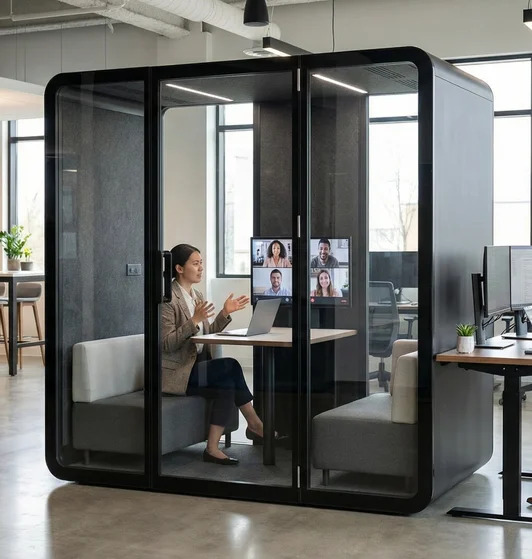
Quiet zones for deep focus. Collaborative hubs for brainstorming. Transition areas for decompression. Private pods for recharging. Each zone serves specific cognitive modes, and people choose the environment that matches their task and their biology. No one works in a setting that fights their nervous system.
Ergonomic Foundations
Chairs, desks and monitors adjusted to individual bodies rather than a statistical midpoint. Sitting, standing, movement. This is not premium furniture. It is baseline infrastructure for health. A workforce in chronic pain is a workforce operating below capacity. Remove the pain, recover the capacity.
Lighting That Respects Biology
Natural daylight maximised. Task lighting adjustable at each workstation. Circadian-aware systems that shift colour temperature through the day. For some minds, bright light is focus. For others, it is overload. Both get what they need.
Acoustic Control
Sound-absorbing materials, quiet zones isolated from high-energy areas, white noise masking where collaboration dominates. Some brains need ambient sound to regulate. Others need near silence. Both are designed for.
Sensory-safe Spaces
Low-stimulation environments for processing-intensive work. Reduced visual clutter, calming palettes, controlled sound. Not niche additions. Essential infrastructure for the cognitive diversity already present in every organisation.
Home Workspace Standards
Ergonomic assessments, equipment provision and ongoing support for remote teams, matching office standards without compromise. Consistency regardless of location.
Biophilic Design
Nature is nervous system regulation, not decoration. Natural light, greenery, organic materials and outdoor views measurably reduce stress and restore cognitive capacity. The brain works better when it feels safe.
This is not our first workspace. We have designed, specified and delivered physical environments for organisations across sectors, with particular depth in the tech industry and for neurodivergent workforces. Tech teams concentrate exactly the minds that standard office design serves worst, and they are often the first to feel it: the engineers who do their best work in silence on floors built for visibility, the analysts who need movement to think in buildings designed for sitting still. When we zone a floor for that population, the results speak in retention and delivery pace, not just comfort.
We bring the commercial discipline of someone who has signed the purchase orders and the design depth of someone who knows why the specification matters. The statistics throughout this page come from that delivery experience, not from a brochure.
Discovery
We audit current spaces against human needs. Where does the environment fight biology? Where does pain accumulate? Interviews with the people who use the spaces daily, and observation of actual work patterns versus intended ones.
Design
Zoning maps, equipment specifications, lighting plans, acoustic treatments, NeuroPod configurations where they fit. Quick wins alongside longer-term restructuring, phased to deliver value incrementally.
Delivery
Agile sprints, not waterfall rollouts. Prototype a quiet pod with one team before going organisation-wide. Trial lighting changes in one zone before committing to a floor. Learn fast, scale what works. Weekly check-ins, staff included as co-designers, retrospectives that keep spaces evolving as work patterns change. Investment compounds rather than depreciates.
We remain until spaces function as designed, and we measure against outcomes: physical strain decreases, absence drops, focus deepens, collaboration improves, remote workers feel equally supported.
For deep-work environments where the open plan cannot provide one, we specify and configure the NeuroPod range: from single-person work pods to the NeuroPod 6 for group work in a controlled sensory environment. Electro-atomised privacy glass switching transparent to opaque on demand. Up to 50dB noise reduction, genuine silence mid-floor. Ambient and task lighting fully controllable, optional climate control, built-in white noise, rain, wind or sea. Configured to the people who will use it and the space it sits within.
The right pod, in the right place, as part of a designed environment. Not a gadget that arrives hoping to be useful.
• Physical strain decreases.
• Absence from musculoskeletal issues drops.
• Focus deepens in quiet zones.
• Collaboration improves in designated hubs.
• Remote workers feel equally supported.
• Energy available for work rather than consumed by discomfort.
Ready To Design For Everyone?
If your organisation wants physical spaces designed for the full spectrum of human variation, book a discovery call. We will audit your situation, identify the highest-leverage starting points, and explore whether our approach fits your context.